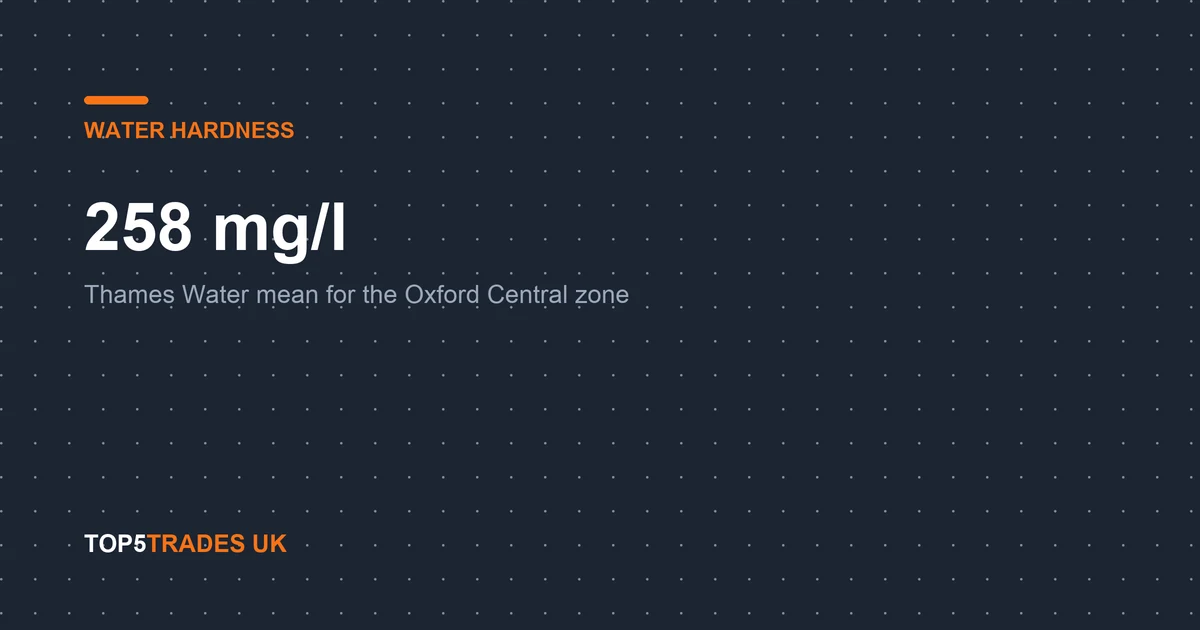
Thames Water says all its supplies are generally hard, and its 2025 data gives the Oxford Central zone a mean of 258 mg/l of total hardness. Hard water leaves scale in a boiler's heat exchanger over time, so ask your engineer about servicing and scale protection.
Thames Water says all supplies in its area are generally hard, caused by chalk and limestone geology, and its 2025 zone data gives the Oxford Central zone a mean total hardness of 258 mg/l as calcium carbonate. On Thames Water’s own scale, 200 to 300 mg/l is hard and above 300 is very hard, and hardness across its whole area runs from 80 to 365 mg/l, so your street may differ from the zone average.
Why the water is hard here
Thames Water explains that hard water is found where the ground is chalk and limestone. As water passes through the rock it picks up carbonates, and the amount sets how hard the water is. There is no health concern, according to Thames Water. The effects are practical: scale, more soap used and reduced detergent performance.
What scale does to a boiler
A boiler heats water continuously, and scale forms on the hottest surfaces, which inside a combi means the heat exchanger. A scaled heat exchanger transfers heat less well, so the boiler works harder, and heavy scale can lead to noise, reduced flow and breakdowns. The effect builds slowly, which is why a yearly service is where it usually gets caught.
What to do about it
- Service the boiler every year and ask the engineer to check for scale.
- Lower the hot water temperature. Thames Water suggests 60 degrees Celsius or less to reduce scale.
- Ask about scale protection. A scale reducer or softener may suit your system. Check your manufacturer’s installation instructions for hard-water requirements, because they can affect the warranty.
If your boiler is already losing pressure, that is a separate fault, covered in why is my boiler losing pressure. If it is time to replace it, see how much a new boiler costs.
Finding an engineer in Oxford
See the top 5 boiler engineers in Oxford for engineers checked on Gas Safe registration and independent reviews, and how we choose for the method.
For other towns, browse our top 5 boiler engineers across the UK.
Frequently asked questions
Is Oxford's water hard or soft?
Hard. Thames Water says all supplies in its area are generally classified as hard, and its 2025 zone data gives Oxford Central a mean of 258 mg/l as calcium carbonate. On Thames Water's own scale, 200 to 300 mg/l is hard and above 300 is very hard.
Why is the water hard around Oxford?
Thames Water says hardness comes from chalk and limestone geology: as water passes through the rock it picks up carbonates, and their concentration sets the level of hardness.
Does hard water damage a boiler?
Scale builds up on the hottest surfaces, including a boiler's heat exchanger, which makes it work harder and can lead to faults. Check your manufacturer's installation instructions for hard-water requirements and have the boiler serviced annually.
What can I do to reduce scale at home?
Thames Water suggests keeping hot water at 60 degrees Celsius or lower and using a stainless steel scale collector in the kettle. For the boiler, ask a Gas Safe engineer whether a scale reducer or softener suits your system.
Related guides
More hard water guides · All boiler engineers guides
About the author

Stu Clark
Stu spent over 15 years in the trades, working as a plumber before running his own plumbing and bathroom renovation company with a team of eight. He founded Top5Trades to give homeowners the kind of shortlist and straight advice you would get from someone who has actually done the work. More about us →